


Louis Addeo-Weiss
-
Posts
3 -
Joined
-
Last visited
1 Follower

Louis Addeo-Weiss's Achievements


-
A good gauge of the state of any professional sport is the crop of young players establishing themselves in their respective medium. For Major League Baseball, a rookie player is thrown to the wolves to see how they fare against the sport's best. Expectations are understandably tempered relative to their veteran counterparts, but this only makes the great seasons these players have all the more intriguing in the larger discourse. And while the award tends to rank lower on many a tier list of end-of-season awards, winning your league's respective Rookie of the Year Award suggests that their respective employers may have something in said player. Since its inception in 1947, 21 players across the American and National Leagues have been inducted into the Hall of Fame, with several contemporary victors trending toward similar honors. Here, I'll give my two cents on who I feel merits the distinction of the 2026 National League Rookie of the Year in another case of new school versus older schools of thought. A good jumping-off point in awards discourse, at least in the modern game, is WAR (Wins Above Replacement). As many a reader here is familiar with, WAR is all-encompassing, taking into account every aspect of player performance: offense, defense, positional hierarchies, and baserunning. Among the 96 NL players who played in 2026 with rookie status, the league's rookies averaged 0.3 bWAR, well below replacement level, a testament to the growing pains of players making a name for themselves against foreign-talented competition. For context, a player worth two wins (give-or-take) is routinely cited as the prototypical league-average player. It goes without saying that the better a player is across all facets of the game, the more WAR sways in their favor. Rookie Of The Year Honorable Mentions Bryce Eldridge (2.1), Konnor Griffin (2.1), A.J. Ewing (3.1), Foster Griffin (3.3). Now, let's get to the strongest candidates this season. 1B/3B Sal Stewart: Cincinnati Reds If you came of age as a baseball fan in an era before analytics became a part of the sport's cultural lexicon, Sal Stewart would be the overwhelming choice here. But why? Simply put, Stewart is a counting-stat merchant. The Miami native's 111 runs batted in were the most by a qualified NL rookie since Pete Alonso drove in 120 in 2019. Since the National League's inception in 1876, only 17 rookies have managed to drive in 100-plus runs. Showcasing plus power, hitting 32 home runs, Stewart became just the fifth rookie this millennium and the fifteenth ever with a season of 30-plus home runs and 100-plus RBIs. An additional feather in his cap was Stewart's durability, appearing in all 162 games this season. In the expansion era dating back to 1961, only nine rookie players appeared in at least 162. There is something to be said for the seldom-seen accomplishments; however, endorsing Stewart speaks to the ignorance of some, respectively. You see, Stewart, for all of his accomplishments at the plate, ended 2026 with just 1.8 bWAR, seventh among NL rookies. Now, having what is essentially a two-win season in your first full season in the big leagues is nothing to scoff at, but for the sake of this exercise, we are. Stewart's adjusted OPS+, a statistic that compares hitters against their contemporaries - where 100 is considered league average- was 117, suggesting he was 17 percent better than a league-average hitter. Another component of WAR is comparing players' performance against their positional peers. Appearing as a first baseman in approximately 72 percent of his games, Stewart hit .270 with an .809 OPS. First base is generally seen as a place where the club's best hitters play the field, as was the case in 2026. By OPS, first basemen were the most productive position offensively, posting a mark of .771. So, while Stewart was better than average, it's not an overwhelmingly significant degree of separation. Keeping with the first base of it all, the defensive spectrum, defined by Fangraphs, fails to be of service to these types of players as compared to, say, a shortstop or a center fielder. But Stewart is not merely a first baseman, appearing in 41 games as a third baseman where he posted a .758 OPS, as well as a seven-game cameo at second base where he was well below average offensively, posting a sub-.600 OPS. And while even a bad defensive second or third baseman offers more positional value than a first base/designated hitter type, Stewart was a below-average defender across the board, finishing in the 29th percentile in outs above average. Would it surprise me to see him claim the hardware? Not necessarily, as there is still an audience for traditional counting stats, but if I had a vote, I'd lean in another direction. RF Carson Benge: New York Mets In a season that saw a franchise-record $351 million committed to its roster, the New York Mets were an absolute disaster. Jonah Tong, who entered the season as one of their most hyped prospects, threw all of just 30-plus innings at the big-league level, while trade acquisition Marcus Semien showed himself to be firmly in decline. Most importantly, the club's $765 million man, Juan Soto, played only 111 games after missing time with injury. We could sit here and ruminate on the abject failure that was the 2026 Mets, but even in their loathing, there were signs of a strong core taking shape. Top pitching prospect Nolan McClean showed that his 2025 debut was no fluke, pitching to a 3.16 ERA across nearly 180 innings of work, firmly establishing himself as a top-of-the-rotation caliber arm. The subject here, though, is Carson Benge. A 2024 first-round pick, Benge cracked the Opening Day roster following a spring training that saw him hit .366 with an on-base percentage approaching .500. While he looked like a veteran out of the gate, homering in his debut, Benge would proceed to go into a prolonged slump. Of the 190 hitters to take at least 100 plate appearances through May 2, Benge's .498 OPS and accompanying 40 wRC+ ranked 187th. And then, he looked like a superstar. From May 3 to the end of the season, Benge hit .302/.366/.462/.828, ending 2026 with 4.3 bWAR. Back to the WAR of it all, that aforementioned figure ranked second among NL rookies, trailing our next topic of discussion. But what made Benge's season such an overwhelming success? Here's an analogy to answer that: think of 2026 Carson Benge as an ALDI grocery store. While it doesn't stock many name-brand items, everything you need to feed yourself can be found there at a cost-effective price. As far as quality, their products tend to steer largely clear of the ultra-processed name brands without sacrificing taste. For Benge, he was an above-average hitter (118 OPS+), an above-average defender (+6 DRS), and an efficient base stealer (22-for-27). Because of this, we see why Benge was an All-Star-caliber player. For the fiscal side of it all, Benge did all of this for the league minimum. In short, he does everything well. 2B JJ Wetherholt: St. Louis Cardinals What do you get when you combine slightly better-than-league-average offense, plus baserunning, and a historic glove at second base? You get our third entry, JJ Wetherholt. Whether you use bWAR or fWAR, Wetherholt was the most valuable NL rookie in 2026, posting 4.5 marks respectively across both internal metrics. Beyond that, Wetherholt did all of this in just 139 games, missing two weeks with right-wrist tendinitis. Imagine what an additional 10-plus games would do for that total. While his 102 OPS+ makes him merely passable at the plate, Wetherholt, like Benge's well-rounded game, has him here. The Cardinals certainly believe in him as well, locking him up on an 8-year, $112.5M extension four months into the season. Circling back to the defense, Wetherholt ranked in the 100th percentile in Outs Above Average (OAA), posting a mark of plus-25. Whether (no pun intended) he wins the Rookie of the Year, he'll for certain be claiming the Gold Glove at second. For context, that is the same mark as the NL MVP frontrunner Pete Crow-Armstrong. And sure, traditionalists will most certainly side with Stewart's bat over Wetherholt's defense; there is something so alluring about bearing witness to what looks like an all-time great second base defender. Even while being below-average offensive players, we were clinically wowed by the play of Andrelton Simmons and Kevin Kiermaier. With Wetherholt, you get all of that and a bat that should only get better with time. That is why, in my humble opinion, he should be the NL Rookie of the Year. View full article
-
Breaking Down The Three Strongest NL Rookie Of The Year Candidates
Louis Addeo-Weiss posted an article in MLB
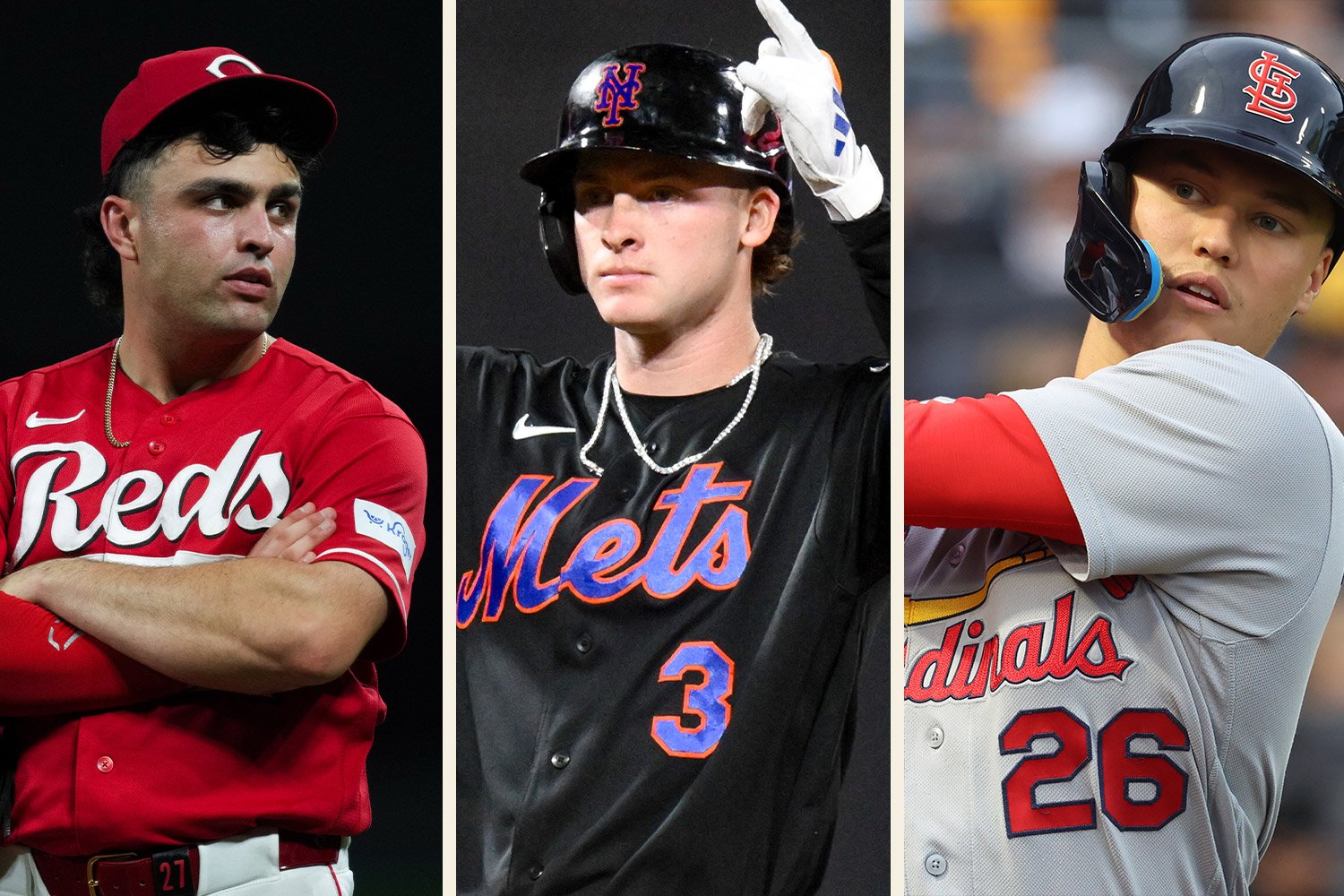 A good gauge of the state of any professional sport is the crop of young players establishing themselves in their respective medium. For Major League Baseball, a rookie player is thrown to the wolves to see how they fare against the sport's best. Expectations are understandably tempered relative to their veteran counterparts, but this only makes the great seasons these players have all the more intriguing in the larger discourse. And while the award tends to rank lower on many a tier list of end-of-season awards, winning your league's respective Rookie of the Year Award suggests that their respective employers may have something in said player. Since its inception in 1947, 21 players across the American and National Leagues have been inducted into the Hall of Fame, with several contemporary victors trending toward similar honors. Here, I'll give my two cents on who I feel merits the distinction of the 2026 National League Rookie of the Year in another case of new school versus older schools of thought. A good jumping-off point in awards discourse, at least in the modern game, is WAR (Wins Above Replacement). As many a reader here is familiar with, WAR is all-encompassing, taking into account every aspect of player performance: offense, defense, positional hierarchies, and baserunning. Among the 96 NL players who played in 2026 with rookie status, the league's rookies averaged 0.3 bWAR, well below replacement level, a testament to the growing pains of players making a name for themselves against foreign-talented competition. For context, a player worth two wins (give-or-take) is routinely cited as the prototypical league-average player. It goes without saying that the better a player is across all facets of the game, the more WAR sways in their favor. Rookie Of The Year Honorable Mentions Bryce Eldridge (2.1), Konnor Griffin (2.1), A.J. Ewing (3.1), Foster Griffin (3.3). Now, let's get to the strongest candidates this season. 1B/3B Sal Stewart: Cincinnati Reds If you came of age as a baseball fan in an era before analytics became a part of the sport's cultural lexicon, Sal Stewart would be the overwhelming choice here. But why? Simply put, Stewart is a counting-stat merchant. The Miami native's 111 runs batted in were the most by a qualified NL rookie since Pete Alonso drove in 120 in 2019. Since the National League's inception in 1876, only 17 rookies have managed to drive in 100-plus runs. Showcasing plus power, hitting 32 home runs, Stewart became just the fifth rookie this millennium and the fifteenth ever with a season of 30-plus home runs and 100-plus RBIs. An additional feather in his cap was Stewart's durability, appearing in all 162 games this season. In the expansion era dating back to 1961, only nine rookie players appeared in at least 162. There is something to be said for the seldom-seen accomplishments; however, endorsing Stewart speaks to the ignorance of some, respectively. You see, Stewart, for all of his accomplishments at the plate, ended 2026 with just 1.8 bWAR, seventh among NL rookies. Now, having what is essentially a two-win season in your first full season in the big leagues is nothing to scoff at, but for the sake of this exercise, we are. Stewart's adjusted OPS+, a statistic that compares hitters against their contemporaries - where 100 is considered league average- was 117, suggesting he was 17 percent better than a league-average hitter. Another component of WAR is comparing players' performance against their positional peers. Appearing as a first baseman in approximately 72 percent of his games, Stewart hit .270 with an .809 OPS. First base is generally seen as a place where the club's best hitters play the field, as was the case in 2026. By OPS, first basemen were the most productive position offensively, posting a mark of .771. So, while Stewart was better than average, it's not an overwhelmingly significant degree of separation. Keeping with the first base of it all, the defensive spectrum, defined by Fangraphs, fails to be of service to these types of players as compared to, say, a shortstop or a center fielder. But Stewart is not merely a first baseman, appearing in 41 games as a third baseman where he posted a .758 OPS, as well as a seven-game cameo at second base where he was well below average offensively, posting a sub-.600 OPS. And while even a bad defensive second or third baseman offers more positional value than a first base/designated hitter type, Stewart was a below-average defender across the board, finishing in the 29th percentile in outs above average. Would it surprise me to see him claim the hardware? Not necessarily, as there is still an audience for traditional counting stats, but if I had a vote, I'd lean in another direction. RF Carson Benge: New York Mets In a season that saw a franchise-record $351 million committed to its roster, the New York Mets were an absolute disaster. Jonah Tong, who entered the season as one of their most hyped prospects, threw all of just 30-plus innings at the big-league level, while trade acquisition Marcus Semien showed himself to be firmly in decline. Most importantly, the club's $765 million man, Juan Soto, played only 111 games after missing time with injury. We could sit here and ruminate on the abject failure that was the 2026 Mets, but even in their loathing, there were signs of a strong core taking shape. Top pitching prospect Nolan McClean showed that his 2025 debut was no fluke, pitching to a 3.16 ERA across nearly 180 innings of work, firmly establishing himself as a top-of-the-rotation caliber arm. The subject here, though, is Carson Benge. A 2024 first-round pick, Benge cracked the Opening Day roster following a spring training that saw him hit .366 with an on-base percentage approaching .500. While he looked like a veteran out of the gate, homering in his debut, Benge would proceed to go into a prolonged slump. Of the 190 hitters to take at least 100 plate appearances through May 2, Benge's .498 OPS and accompanying 40 wRC+ ranked 187th. And then, he looked like a superstar. From May 3 to the end of the season, Benge hit .302/.366/.462/.828, ending 2026 with 4.3 bWAR. Back to the WAR of it all, that aforementioned figure ranked second among NL rookies, trailing our next topic of discussion. But what made Benge's season such an overwhelming success? Here's an analogy to answer that: think of 2026 Carson Benge as an ALDI grocery store. While it doesn't stock many name-brand items, everything you need to feed yourself can be found there at a cost-effective price. As far as quality, their products tend to steer largely clear of the ultra-processed name brands without sacrificing taste. For Benge, he was an above-average hitter (118 OPS+), an above-average defender (+6 DRS), and an efficient base stealer (22-for-27). Because of this, we see why Benge was an All-Star-caliber player. For the fiscal side of it all, Benge did all of this for the league minimum. In short, he does everything well. 2B JJ Wetherholt: St. Louis Cardinals What do you get when you combine slightly better-than-league-average offense, plus baserunning, and a historic glove at second base? You get our third entry, JJ Wetherholt. Whether you use bWAR or fWAR, Wetherholt was the most valuable NL rookie in 2026, posting 4.5 marks respectively across both internal metrics. Beyond that, Wetherholt did all of this in just 139 games, missing two weeks with right-wrist tendinitis. Imagine what an additional 10-plus games would do for that total. While his 102 OPS+ makes him merely passable at the plate, Wetherholt, like Benge's well-rounded game, has him here. The Cardinals certainly believe in him as well, locking him up on an 8-year, $112.5M extension four months into the season. Circling back to the defense, Wetherholt ranked in the 100th percentile in Outs Above Average (OAA), posting a mark of plus-25. Whether (no pun intended) he wins the Rookie of the Year, he'll for certain be claiming the Gold Glove at second. For context, that is the same mark as the NL MVP frontrunner Pete Crow-Armstrong. And sure, traditionalists will most certainly side with Stewart's bat over Wetherholt's defense; there is something so alluring about bearing witness to what looks like an all-time great second base defender. Even while being below-average offensive players, we were clinically wowed by the play of Andrelton Simmons and Kevin Kiermaier. With Wetherholt, you get all of that and a bat that should only get better with time. That is why, in my humble opinion, he should be the NL Rookie of the Year.
