TomCent
-
Posts
4 -
Joined
-
Last visited
1 Follower

TomCent's Achievements


-
Image courtesy of © Brad Penner-Imagn Images Hey, have you gotten in on this hot new market? "Yes or No: will Rob Manfred and MLB ever express shame about being nakedly greedy and hypocritical?" Trick question --- no one would put that prop online, because the percentage for "No" would never get below 100. That goes double for any outfit that signs a partnership agreement with baseball. Like Polymarket, the bookmaker that's cleverly disguised as a sports options contract broker. This week, it agreed to pay MLB $150 million to $300 million over three years (per Front Office Sports) to be the league's official prediction market exchange. In return, MLB will lavish data and licensing rights upon the company. That means there's a 98 percent chance Polymarket will display all of the correct club logos whenever MLB betting lines --- sorry, contracts --- go live this season. Polymarket should celebrate this deal because it strengthens its business. Baseball, on the other hand, should be ashamed for partnering with an operation that openly skirts the law, and also for showing no appreciation of its history. For decades, baseball was virulently opposed to the establishment or expansion of legal sports betting. The commissioner's office is a direct legacy of baseball's most corrupt period. The first commissioner, Judge Kennesaw Mountain Landis, was hired to clean up the sport after Chicago's Black Sox fixed World Series games in 1919. When A. Bartlett Giamatti banned Pete Rose from baseball for life 70 years later for wagering on games, many involving his own team, the rule was ironclad: No betting allowed. In 2018, the U.S. Supreme Court ruled the Professional and Amateur Sports Protection Act (PASPA), which severely limited the scope of legal sports betting, unconstitutional. The decision opened up sports betting to all 50 states. Baseball could have led by example and refused to make marketing deals with sportsbooks, but the money was just too good. In 2023, MLB made FanDuel its official sports betting partner. Now, the league has joined the NHL, the UFC, and MLS in selling access to a company that has been accused of illegal activities. A number of state regulators consider Polymarket, Kalshi, and other exchanges illegal bookmakers. But the exchanges have a champion in the federal Commodity Futures Trading Commission (CFTC), the Trump administration-influenced body that oversees these companies. The CFTC regards sports prediction markets as being similar to securities traders. That means the exchanges are staying. MLB and the CFTC will share information under an agreement completed in conjunction with the Polymarket deal. "I hope that it goes without saying that our primary concern, always first in our minds, is protecting the integrity of the game," Manfred said in his announcement of the agreement (per ESPN). "I think in today's world, it is really important not to be chasing developments but try to be involved and in front of those developments because our world is so fast-moving." On Friday, the league and the players' association reminded people of the sport's sordid past. The parties announced that the administrative leaves of former Guardians pitchers Emmanuel Clase and Luis Ortiz for allegedly fixing games had changed from paid to unpaid. The two men are accused of intentionally throwing pitches out of the strike zone to help bettors win in-game prop wagers. The league will wait for the legal cases to wrap up before it administers discipline, which could be as severe as a lifetime ban. Last year, Manfred reinstated Rose and "Shoeless" Joe Jackson, one of the Black Sox's "Eight Men Out," from MLB's ineligible list posthumously. He erased the hard line that he and his predecessors had drawn for people who took part in gambling scandals. Maybe Clase and Ortiz will suffer similar fates in time. But after the Polymarket deal, baseball has ceded the moral high ground for good when it comes to gambling. Its integrity is gone because too many bucks are to be made. View full article
-
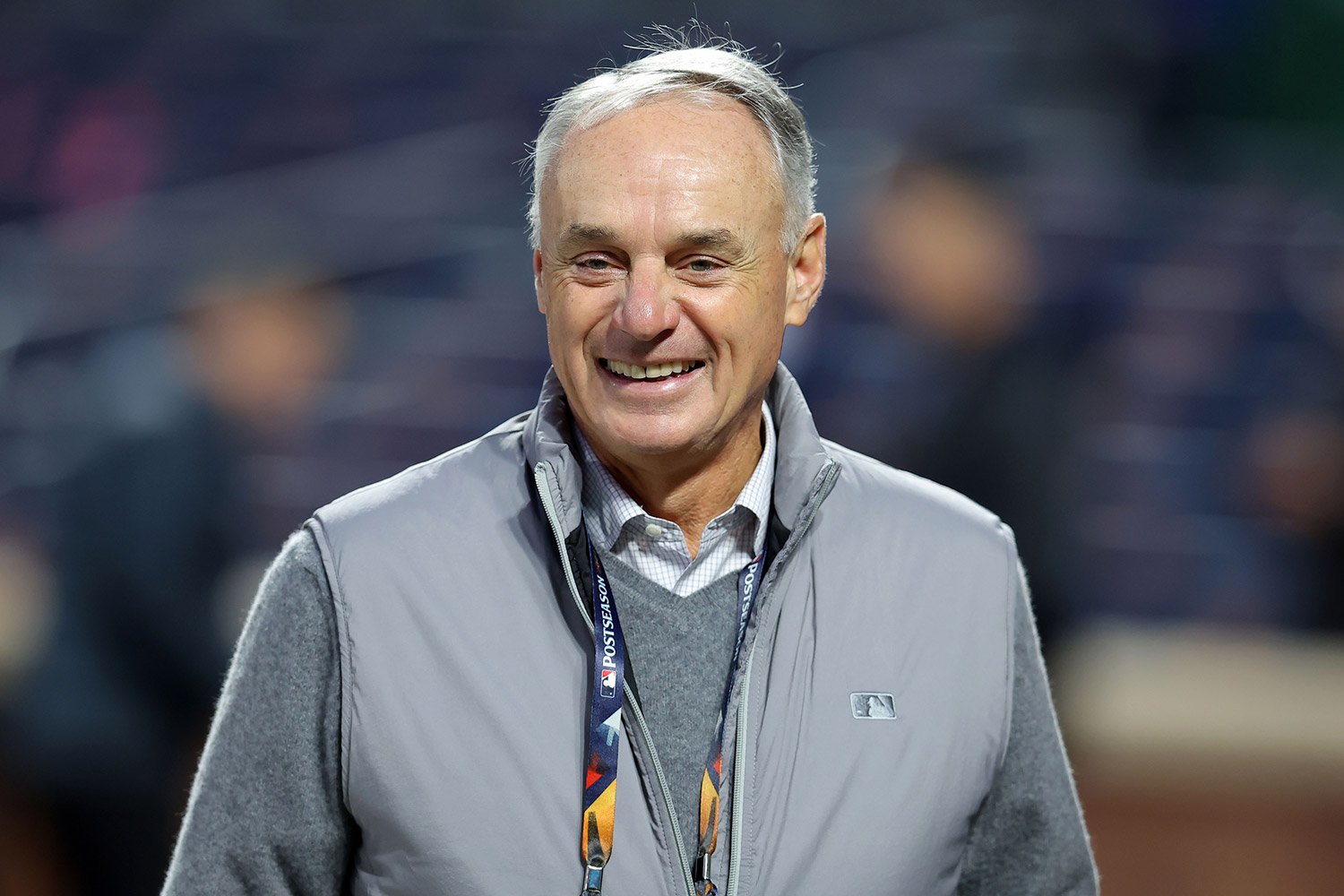 Hey, have you gotten in on this hot new market? "Yes or No: will Rob Manfred and MLB ever express shame about being nakedly greedy and hypocritical?" Trick question --- no one would put that prop online, because the percentage for "No" would never get below 100. That goes double for any outfit that signs a partnership agreement with baseball. Like Polymarket, the bookmaker that's cleverly disguised as a sports options contract broker. This week, it agreed to pay MLB $150 million to $300 million over three years (per Front Office Sports) to be the league's official prediction market exchange. In return, MLB will lavish data and licensing rights upon the company. That means there's a 98 percent chance Polymarket will display all of the correct club logos whenever MLB betting lines --- sorry, contracts --- go live this season. Polymarket should celebrate this deal because it strengthens its business. Baseball, on the other hand, should be ashamed for partnering with an operation that openly skirts the law, and also for showing no appreciation of its history. For decades, baseball was virulently opposed to the establishment or expansion of legal sports betting. The commissioner's office is a direct legacy of baseball's most corrupt period. The first commissioner, Judge Kennesaw Mountain Landis, was hired to clean up the sport after Chicago's Black Sox fixed World Series games in 1919. When A. Bartlett Giamatti banned Pete Rose from baseball for life 70 years later for wagering on games, many involving his own team, the rule was ironclad: No betting allowed. In 2018, the U.S. Supreme Court ruled the Professional and Amateur Sports Protection Act (PASPA), which severely limited the scope of legal sports betting, unconstitutional. The decision opened up sports betting to all 50 states. Baseball could have led by example and refused to make marketing deals with sportsbooks, but the money was just too good. In 2023, MLB made FanDuel its official sports betting partner. Now, the league has joined the NHL, the UFC, and MLS in selling access to a company that has been accused of illegal activities. A number of state regulators consider Polymarket, Kalshi, and other exchanges illegal bookmakers. But the exchanges have a champion in the federal Commodity Futures Trading Commission (CFTC), the Trump administration-influenced body that oversees these companies. The CFTC regards sports prediction markets as being similar to securities traders. That means the exchanges are staying. MLB and the CFTC will share information under an agreement completed in conjunction with the Polymarket deal. "I hope that it goes without saying that our primary concern, always first in our minds, is protecting the integrity of the game," Manfred said in his announcement of the agreement (per ESPN). "I think in today's world, it is really important not to be chasing developments but try to be involved and in front of those developments because our world is so fast-moving." On Friday, the league and the players' association reminded people of the sport's sordid past. The parties announced that the administrative leaves of former Guardians pitchers Emmanuel Clase and Luis Ortiz for allegedly fixing games had changed from paid to unpaid. The two men are accused of intentionally throwing pitches out of the strike zone to help bettors win in-game prop wagers. The league will wait for the legal cases to wrap up before it administers discipline, which could be as severe as a lifetime ban. Last year, Manfred reinstated Rose and "Shoeless" Joe Jackson, one of the Black Sox's "Eight Men Out," from MLB's ineligible list posthumously. He erased the hard line that he and his predecessors had drawn for people who took part in gambling scandals. Maybe Clase and Ortiz will suffer similar fates in time. But after the Polymarket deal, baseball has ceded the moral high ground for good when it comes to gambling. Its integrity is gone because too many bucks are to be made.
 -
Image courtesy of © Brett Davis-Imagn Images Rob Manfred knows how to give a non-answer, so people took notice last week when MLB's commissioner actually sounded semi-candid during an interview. Of course, he didn't make a bold statement, but it did qualify as a rare unguarded moment. And it's now the jumping-off point for what follows here. Quick setup: Manfred stopped by the WFAN Radio/Audacy studios in New York on Thursday for a sitdown with Craig Carton and Chris McMonigle. About two-thirds of the way through the 35-minute session, the conversation shifted to expansion and realignment. First, the commissioner reiterated his hope that MLB will go to 32 clubs around the time he retires in 2029. Then came the moment. Manfred wants his expanded league to be divided into eight, four-team divisions based on geography. McMonigle, perhaps recalling commissioner emeritus Bud Selig's "radical realignment" dream from the '90s, asked whether that meant the Mets and Yankees, or any of the teams that share a market, would share a division. "I think you would try to keep the two-team cities separate," Manfred replied. "That would be my thinking. (But) a lot of water's got to go over that dam." Well, that was new and, well, newsworthy. But if New York, Chicago, greater Los Angeles, and DC/Baltimore aren't going to be together, then how would they and the rest of the league line up? Manfred, of course, didn't provide details. Fortunately, others (read: yours truly) are free to share their thoughts on what should happen, so here's one fan's attempt to fill in the blanks. First, Manfred defines "geographically" as an Eastern Conference and a Western Conference, similar to the NBA and NHL. That gives us the base for our plan. In our world, the conferences would be set up in such a way that disruption is limited and a sliver of baseball tradition is preserved. POTENTIAL MLB DIVISIONAL FORMAT EASTERN CONFERENCE Atlantic Division: Baltimore Orioles, Boston Red Sox, New York Yankees, Toronto Blue Jays Central Division: Chicago White Sox, Cincinnati Reds, Cleveland Guardians, Detroit Tigers Northeast Division: New York Mets, Philadelphia Phillies, Pittsburgh Pirates, Washington Nationals Southeast Division: Atlanta Braves, Miami Marlins, Tampa Bay Rays, Carolina or Nashville (expansion club; sorry, Expos fans) WESTERN CONFERENCE Continental Division: Colorado Rockies, Houston Astros, Minnesota Twins, Texas Rangers Midwest Division: Chicago Cubs, Kansas City Royals, Milwaukee Brewers, St. Louis Cardinals Pacific Division: Arizona Diamondbacks, Los Angeles Dodgers, San Diego Padres, San Francisco Giants Western Division: Las Vegas Athletics, Los Angeles Angels, Seattle Mariners, Portland or Utah (expansion club; sorry, Oakland fans) Why it works: This plan keeps some American League and National League rivalries together, even though a geographic split would kill the AL and NL for good. More importantly, these new divisions would reduce travel by at least a small amount. That's a big Manfred selling point. East Coast teams would play just 27 or 28 games outside their time zone if MLB expands to Raleigh. In 2026, they'll play between 33 and 47 games outside their time zone. A team like the Mariners, who have one of the heaviest travel burdens in baseball every year, would go from 99 games in the Pacific time zone to 112 if MLB expands to Portland. This setup should also reduce the number of incoherent three-city trips, but there might still be the odd Phoenix-San Diego-Chicago jaunt, like the one the Marlins will have to endure in late September. POTENTIAL MLB SCHEDULE BREAKDOWN (EAST AND WEST) 36 games against division opponents (3 clubs x 12 games each) 78 games against the rest of the conference (6 clubs x 6 games, 6 clubs x 7 games) 48 interconference games (16 clubs x 3 games) 162 games total Why it works: Mostly, it works because the simple math keeps the season at 162 games. Talk in recent years about going down to 154 games hasn't been well-received. Clubs aren't giving up home gates, not when overall attendance is high. POTENTIAL STANDINGS CHANGE It would be cool if a realigned MLB emphasized conference standings the way the NBA does. Like pro basketball, baseball's divisions would stay around for scheduling purposes, but only the teams with the best records would advance to the postseason. Division champs would not be guaranteed playoff berths, so no Carolina Panthers situations. To illustrate how conference standings in a realigned MLB would look, here is the top seven in the East and West based on 2025 records. For this exercise, the tiebreakers went this way: MLB EAST Team Wins Losses Win % Philadelphia 96 66 .593 Toronto 94 68 .580 NY Yankees 94 68 .580 Boston 89 73 .549 Cleveland 88 74 .543 Detroit 87 75 .537 Cincinnati 83 79 .512 MLB WEST Team Wins Losses Win % Milwaukee 97 65 .599 LA Dodgers 93 69 .574 Chicago Cubs 90 72 .556 Seattle 90 72 .556 San Diego 90 72 .556 Houston 87 75 .537 Kansas City 82 80 .506 POTENTIAL MLB POSTSEASON CHANGE As to those playoffs, MLB could both expand the field by two (more October games = more October cash) and streamline TV scheduling under this plan. The latter is another Manfred priority. Baseball would expand to seven playoff teams in each conference, matching the NFL, and base seeding on the conference standings, like in the NBA. However, there would be no NBA-style play-in tournament. As in the NFL, only the conference champion would receive a first-round bye, with the six remaining clubs squaring off in the Wild Card Series. Based once again on 2025 records (see above), these would be the matchups: East: Philadelphia bye; Cincinnati at Toronto, Detroit at Yankees, Cleveland at Boston. West: Milwaukee bye; Kansas City at Dodgers, Houston at Cubs, San Diego at Seattle. Bye-bye to Boston vs. "Anaheim," the hypothetical series Manfred always cites when pitching realignment. The Wild Card winners would advance to the Division Series (maybe renamed the Conference Semifinals), with the lowest remaining seed taking on the top seed and the middle seeds meeting (bye-bye, bracket). The League Championship Series would become the Conference Finals, and the World Series would ... well, it would remain the World Series. It would just be East vs. West instead of American vs. National. In your mind, would any of this still be baseball? The game on the field wouldn't change, but the business would look a lot more like the leagues that are more popular (the NFL) or have long threatened to become more popular (the NBA). It makes sense to follow the leaders, but baseball's uniqueness would continue to fade. That feels like a bad thing. View full article
-
 Rob Manfred knows how to give a non-answer, so people took notice last week when MLB's commissioner actually sounded semi-candid during an interview. Of course, he didn't make a bold statement, but it did qualify as a rare unguarded moment. And it's now the jumping-off point for what follows here. Quick setup: Manfred stopped by the WFAN Radio/Audacy studios in New York on Thursday for a sitdown with Craig Carton and Chris McMonigle. About two-thirds of the way through the 35-minute session, the conversation shifted to expansion and realignment. First, the commissioner reiterated his hope that MLB will go to 32 clubs around the time he retires in 2029. Then came the moment. Manfred wants his expanded league to be divided into eight, four-team divisions based on geography. McMonigle, perhaps recalling commissioner emeritus Bud Selig's "radical realignment" dream from the '90s, asked whether that meant the Mets and Yankees, or any of the teams that share a market, would share a division. "I think you would try to keep the two-team cities separate," Manfred replied. "That would be my thinking. (But) a lot of water's got to go over that dam." Well, that was new and, well, newsworthy. But if New York, Chicago, greater Los Angeles, and DC/Baltimore aren't going to be together, then how would they and the rest of the league line up? Manfred, of course, didn't provide details. Fortunately, others (read: yours truly) are free to share their thoughts on what should happen, so here's one fan's attempt to fill in the blanks. First, Manfred defines "geographically" as an Eastern Conference and a Western Conference, similar to the NBA and NHL. That gives us the base for our plan. In our world, the conferences would be set up in such a way that disruption is limited and a sliver of baseball tradition is preserved. POTENTIAL MLB DIVISIONAL FORMAT EASTERN CONFERENCE Atlantic Division: Baltimore Orioles, Boston Red Sox, New York Yankees, Toronto Blue Jays Central Division: Chicago White Sox, Cincinnati Reds, Cleveland Guardians, Detroit Tigers Northeast Division: New York Mets, Philadelphia Phillies, Pittsburgh Pirates, Washington Nationals Southeast Division: Atlanta Braves, Miami Marlins, Tampa Bay Rays, Carolina or Nashville (expansion club; sorry, Expos fans) WESTERN CONFERENCE Continental Division: Colorado Rockies, Houston Astros, Minnesota Twins, Texas Rangers Midwest Division: Chicago Cubs, Kansas City Royals, Milwaukee Brewers, St. Louis Cardinals Pacific Division: Arizona Diamondbacks, Los Angeles Dodgers, San Diego Padres, San Francisco Giants Western Division: Las Vegas Athletics, Los Angeles Angels, Seattle Mariners, Portland or Utah (expansion club; sorry, Oakland fans) Why it works: This plan keeps some American League and National League rivalries together, even though a geographic split would kill the AL and NL for good. More importantly, these new divisions would reduce travel by at least a small amount. That's a big Manfred selling point. East Coast teams would play just 27 or 28 games outside their time zone if MLB expands to Raleigh. In 2026, they'll play between 33 and 47 games outside their time zone. A team like the Mariners, who have one of the heaviest travel burdens in baseball every year, would go from 99 games in the Pacific time zone to 112 if MLB expands to Portland. This setup should also reduce the number of incoherent three-city trips, but there might still be the odd Phoenix-San Diego-Chicago jaunt, like the one the Marlins will have to endure in late September. POTENTIAL MLB SCHEDULE BREAKDOWN (EAST AND WEST) 36 games against division opponents (3 clubs x 12 games each) 78 games against the rest of the conference (6 clubs x 6 games, 6 clubs x 7 games) 48 interconference games (16 clubs x 3 games) 162 games total Why it works: Mostly, it works because the simple math keeps the season at 162 games. Talk in recent years about going down to 154 games hasn't been well-received. Clubs aren't giving up home gates, not when overall attendance is high. POTENTIAL STANDINGS CHANGE It would be cool if a realigned MLB emphasized conference standings the way the NBA does. Like pro basketball, baseball's divisions would stay around for scheduling purposes, but only the teams with the best records would advance to the postseason. Division champs would not be guaranteed playoff berths, so no Carolina Panthers situations. To illustrate how conference standings in a realigned MLB would look, here is the top seven in the East and West based on 2025 records. For this exercise, the tiebreakers went this way: MLB EAST Team Wins Losses Win % Philadelphia 96 66 .593 Toronto 94 68 .580 NY Yankees 94 68 .580 Boston 89 73 .549 Cleveland 88 74 .543 Detroit 87 75 .537 Cincinnati 83 79 .512 MLB WEST Team Wins Losses Win % Milwaukee 97 65 .599 LA Dodgers 93 69 .574 Chicago Cubs 90 72 .556 Seattle 90 72 .556 San Diego 90 72 .556 Houston 87 75 .537 Kansas City 82 80 .506 POTENTIAL MLB POSTSEASON CHANGE As to those playoffs, MLB could both expand the field by two (more October games = more October cash) and streamline TV scheduling under this plan. The latter is another Manfred priority. Baseball would expand to seven playoff teams in each conference, matching the NFL, and base seeding on the conference standings, like in the NBA. However, there would be no NBA-style play-in tournament. As in the NFL, only the conference champion would receive a first-round bye, with the six remaining clubs squaring off in the Wild Card Series. Based once again on 2025 records (see above), these would be the matchups: East: Philadelphia bye; Cincinnati at Toronto, Detroit at Yankees, Cleveland at Boston. West: Milwaukee bye; Kansas City at Dodgers, Houston at Cubs, San Diego at Seattle. Bye-bye to Boston vs. "Anaheim," the hypothetical series Manfred always cites when pitching realignment. The Wild Card winners would advance to the Division Series (maybe renamed the Conference Semifinals), with the lowest remaining seed taking on the top seed and the middle seeds meeting (bye-bye, bracket). The League Championship Series would become the Conference Finals, and the World Series would ... well, it would remain the World Series. It would just be East vs. West instead of American vs. National. In your mind, would any of this still be baseball? The game on the field wouldn't change, but the business would look a lot more like the leagues that are more popular (the NFL) or have long threatened to become more popular (the NBA). It makes sense to follow the leaders, but baseball's uniqueness would continue to fade. That feels like a bad thing.