


MLB Video
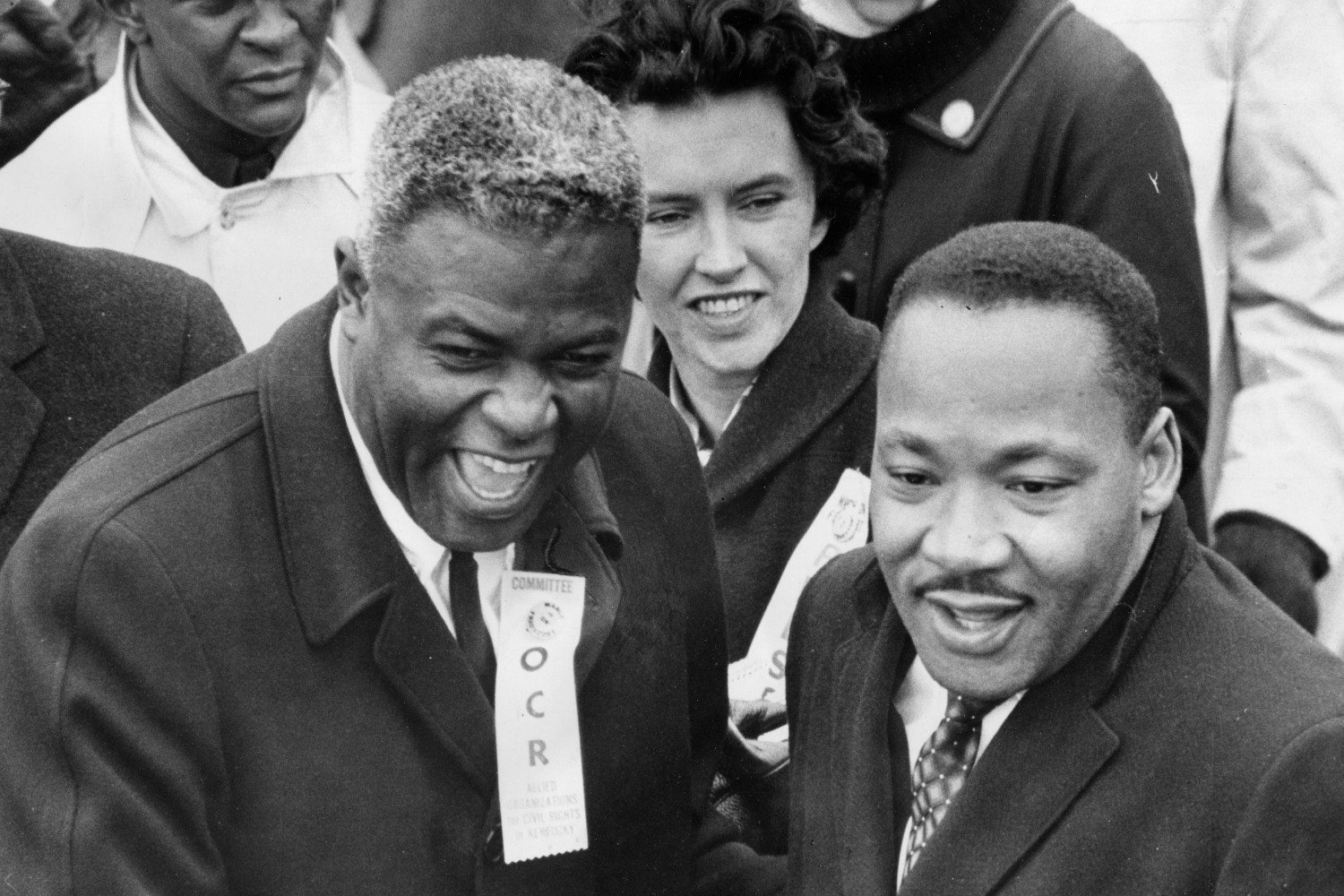
Just as America has not completed the realization of Dr. Martin Luther King Jr.'s famous dream, professional baseball—America's pastime, and the battleground on which some of the first triumphs of the post-World War II Civil Rights Movement were won—has not finished its journey from a segregated and often backward game to an engine of positive change and open-mindedness. King owed quite a bit to Jackie Robinson, but by the end of King's life, baseball (like every other important American institution) owed something to King, too. We are not finished paying that debt; we have defaulted on some of the lines of humanitarian credit taken out on our behalf by the entire movement of which King was the head.
Yet, there's hope now for a better American future, because we can look to a nobler and more moral American past than King and his peers could. They had to forge a belief that the beatings and bombings and lynchings used to dissuade them from demanding basic human rights could be survived, and that America had within it enough people to sustain those demands. They had little real historical evidence in which to ground that hope, so they had to generate faith. Now, they—not only King, of course, but Malcolm X, Fannie Lou Hamer, Ella Baker, and others too numerous to name—give us that precedent, and lighten our burden.
In baseball, the name most famously linked to King and to the Civil Rights Movement is Robinson's, and with good reason. Like King, Robinson had plenty of forebears and contemporaries who also deserve recognition, both for enduring the hatred and maltreatment they received for wanting equity and inclusion in Major League Baseball and for the ways in which they spoke out for or inspired people of color in other walks of life. However, Roberto Clemente is also one of the vital pioneers of racial progress in baseball. So are Alex Carrasquel and Ozzie Virgil. On this Martin Luther King Jr. Day, let's take a moment to consider both why those players' legacies are discussed in different silos than Robinson's. It might tell us something important about the racial distinctions we still draw too readily in the United States, and about the way baseball interacts with what's going on throughout the country in early 2026.
There were, in effect, three or four Civil Rights Movements by the mid-1960s. King and his many colleagues, collaborators and rivals fought for justice and progress on behalf of all people of color, but their efforts focused conspicuously on the American Black population—the descendants, almost exclusively, of people kidnapped and trafficked to the States from Africa. Their message was global, which was why it was successful, but it was also deeply rooted in the experience of those enslaved people and their progeny. The experience of Black Americans was vastly different than those of American Indians, Latinos, and Asian Americans, even after slavery was abolished and as the Great Migration carried Black people across the country, where they began to encounter more of those other minority groups.
King had the right words for this problem, but he never gave it his full attention. Had he not been assassinated, he might one day have landed on the right way to bridge the gap between his main constituency and the other minority groups suffering unique flavors of discrimination and marginalization, but he never did. Instead, we have only scant evidence of collaboration or communication between King and the Latino version of the Civil Rights Movement, led at that time by Cesar Chavez and Dolores Huerta.
"As brothers in the struggle for equality, I extend the hand of fellowship and goodwill and wish you and your members continued success," King wrote to Chavez in 1966. "Our separate struggles are really one—a struggle for freedom, for dignity, and for humanity.”
That much was true, but that the two movements never fully fused speaks to how different their experiences and chief concerns were. The movement Chavez and Huerta led was more urgently tied to the labor movement. They used the same Gandhi-inspired nonviolent approach King championed, but their rhetoric was very different, because people from Latin America conceptualize race quite differently from most in the United States. Language is, of course, an important dynamic. So is geography. Because most Black Americans were denied even the knowledge of their homeland, let alone an understanding of which nation or tribe they belonged to before being stolen and enslaved, the communal identity forged by Black people here is distinctly American. Not so for most Latino people, whose families came here from places still alive in their memories and available to visit—or who have lived where they do now since long before it was considered part of the United States.
White people in the U.S. have often treated Latino people differently from Black people, too. The disease of racism that spread throughout the continent and became a parasitic but inextricable characteristic of the nation built upon it led many to think in incredibly simplistic terms, with the result being that many virulent racists held more sympathetic views of Latino people than of Black people because the former group's skin is (on average, in populations with wide ranges of hues that very much overlap) a bit lighter. Discrimination based on the fluency of a native Spanish speaker's English is common, but the language barrier often created a different kind of interaction between White people and Latinos.
The aspiration King articulated lies at the heart of every rightly American endeavor. We were born, as a nation, under the banner of "Life, Liberty and the Pursuit of Happiness," but we should exchange that motto for one not hypocritically heaved forward by an owner of slaves in the construction of a country where women couldn't vote and minorities of all kinds were denied those "unalienable rights". King said we should all seek "Freedom, Dignity and Humanity," and while he never found any more forceful way to mesh his own movement with the one in support of Latino people than by inviting organizers to turn out Latinos for the March on Washington in 1965, we can use those words as guideposts in our own pursuity of the dream KIng spoke of at that March.
"In a sense, we’ve come to our nation’s capital to cash a check," King said that day. "When the architects of our Republic wrote the magnificent words of the Constitution and the Declaration of Independence, they were signing a promissory note to which every American was to fall heir."
That check remains valid, and has been endorsed, but it hasn't yet been cashed in the full amount. King probably knew it wouldn't be cashed on the spot, or within a few years. Sixty years later, though, the debt has only grown.
This brings us to what's happening in the United States right now, and to the entanglement of the Black experience, the Latino experience, and baseball. Baseball has always been, for one thing, where those two minority groups coexisted in an especially interesting way. Indeed, in players like Roberto Clemente and Rico Carty, there were even examples from the early years after integration of players from Caribbean nations who looked as Black as many African-American players but had the same language and lived experiences as many of their lighter-skinned countrymen. In the early days of Major League Baseball's integration, most non-White players were African-American, but now, the game is powered as much by stars from the Dominican Republic, Venezuela and Puerto Rico as by any racial or geographic group—even White Americans. Baseball looks like America, even though it must borrow heavily from other countries to get the impression right.
Thus, baseball is under threat, because America is under threat. In the Twin Cities, the Somali-American community—one of the few large enclaves of Black people in the United States who do have an unmuddled historical, linguistic and cultural identity, distinct from America's, but most of whom have lived and worked and gradually assimilated themselves here over the 30-plus years since war in Somalia first began to prompt refugees to flee—is under assault, and while few Somali-Americans play baseball, the impacts reach into baseball communities with both hands. The same agents terrorizing Somali-Americans in Minneapolis do so to Venezuelan and other Latino populations, indiscriminately (though very discriminatorily). Throughout the country, many people of color—including and especially Latinos, even if they be documented residents or American citizens—feel unsafe to do simple tasks or go to work or school.
Baseball players fall into these categories. If the season resumes in March under the conditions many American cities face now, inevitably, a baseball player will be kidnapped and unlawfully detained by Immigration and Customs Enforcement (ICE) agents. Because the check King brought hundreds of thousands to the steps of the Lincoln Memorial to cash has still not been paid out in full, we haven't yet bought our full inheritance as a nation. We've backslid. This is neither an indictment of King's legacy, nor a sign that his movement failed, but it is proof that the dream he articulated can't come true just once. It has to come true anew every day, through a shared commitment to progress and a fierce rejection of the hallmarks of the old, bad ways: abduction and forcible relocation; extrajudicial killing without consequence; and segregation, whether by law or by default.
Baseball is no longer America's pastime, but it's still a place where America comes together. America's legacy of imperialism and institutional racism is tied up in the game, but so is its long, indomitable fight to be better. We have come a long, long way since the days of Dr. King. We have also not come nearly far enough. Baseball bears an institutional responsibility to act and to speak for its players and fans, but as baseball fans, we also bear a shared, individual responsibility: to continue a struggle for freedom, dignity and humanity, for all people. At a moment when even the extremely rich young men who play this child's game for a living might not have a guarantee of those things, that struggle is as urgent as ever.
Do you care more about MLB mandating a salary floor or a salary cap?

Follow DiamondCentric For Major League Baseball News & Analysis


Like what you've read here? Check out our team-specific sites and expand your fandom!








-
 1
1


Recommended Comments
There are no comments to display.
If you have an account on one of the following sites, you have a DiamondCentric account.
Twins Daily, Brewer Fanatic, North Side Baseball, Talk Sox, Jays Centre, Padres Mission, Royals Keep, Grand Central Mets, Fish On First.
Create an account or sign in to comment
You need to be a member in order to leave a comment
Create an account
Sign up for a new account in our community. It's easy!
Register a new accountSign in
Already have an account? Sign in here.
Sign In Now