


MLB Video
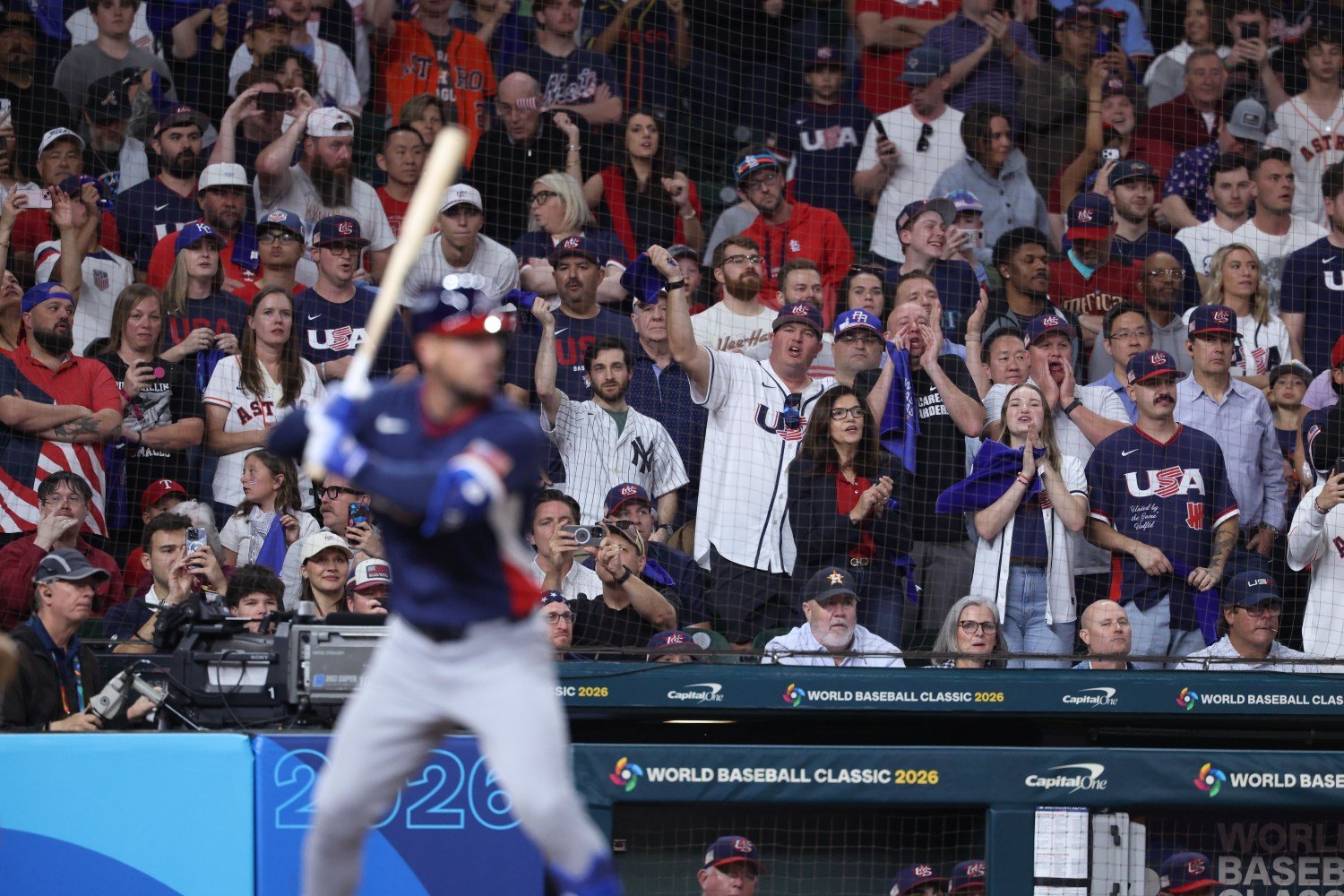
The culture of baseball is a vibrant, diverse, global thing, and the World Baseball Classic is a delightful reminder of that. The intensity of the players elevates the game, and the enthusiasm of the fans—playing instruments, singing coordinated songs, painting their faces and draping themselves in flags, roaring cacophonously at big moments—creates an energy fans from the U.S. can only compare to the playoffs.
Even fans watching on TV, rather than in person, constantly remark on the ecstasy of the atmosphere. The event is enormously popular, growing exponentially in popularity each time it happens, and rightfully so. However, one country is excepted from virtually every expression of praise for the tournament and its milieu: the United States itself.
Many people on social media spend the WBC rejoicing in the exuberance of other countries' players (their celebrations, scripted and otherwise; their underdog stories; and their obvious hunger to win) and their fans, but bemoaning the lack of the same flavor from the United States. To be clear, this isn't unfair, as far as it goes. By contrast with the irrepressible attitudes of the teams from everywhere else, Team USA has a stodgy streak. They're intense, but in a more workmanlike way, at least on the surface. Meanwhile, American fans plainly enjoy the games, but they don't demonstrate the same roaring, often desperate passion as fans from most of the other countries involved.
First, let's acknowledge this much: U.S. fans have been accused of disinterest in the tournament, which is partly fair; too many of them are still awakening to the joy of it. However, there's a rational, even just reason for that circumspect feeling: fans in the U.S. have MLB to call their own. Long before there was robust international baseball competition of any kind, there was Major League Baseball. Its roots are so deep and its season is so inextricably tied to the idea of baseball itself in the States that those fans have had a much longer learning curve for the balancing of priorities between their favorite teams and the tournament that other countries' fans have had.
Puerto Rico and the countries of the Caribbean basin mostly have short, festive winter seasons. Many of their best players play in the U.S. Japan, Korea, Taiwan, México, Australia, Cuba and Nicaragua have longer, fuller domestic seasons, but again, many of their heroes go to MLB to find their fame and fortune. Team Italy has been the Cinderella of this year's tournament, but it (and frequent past underdog, the Netherlands) is essentially a purpose-built outfit. The club is made up mostly of big-leaguers, and the domestic leagues in those countries are small and relatively low-caliber.
Thus, the countries who play winter ball have developed cultures wherein almost every baseball game is a party, and almost every game has high stakes. The countries with longer-running but lower-caliber leagues are conscious of the opportunity the WBC affords, to show what makes their baseball great and that they have talent commensurate with that of the U.S., even though the Western superpower gets the honor of hosting the world's top league. The teams who congeal just for this tournament are savoring a special opportunity to grow the game in the countries they represent,
Meanwhile, for both fans and players from the U.S., it's not immediately clear that the tournament should be more important than the long summer season to which they're looking forward. I think it should be treated with at least equal weight, and probably as more important, but it's easier for every other team and their supporters to arrive at that conclusion than for those from the States. That's related to another thing that separates the U.S. from the other teams and fan bases: that 162-game grind.
I'm not sure it's fair that we expect players and fans from the States to process any form of baseball the same way other nations' and territories' players and fans do. It's the U.S. that made baseball the game of the long season, beginning in early spring and not winding down until Halloween. Everyone here now takes for granted that that's how the game works, but in much of the rest of the world, it isn't. Yes, most great Dominican, Venezuelan and Puerto Rican players eventually come to the States and play those long seasons, but the domestic baseball calendar is short and intense. The same approach is not electively eschewed in the U.S.; it's just impossible. Playing nine days out of every 10 for six full months forces an even keel and a workaday mindset on everyone who attempts it. It would be both draining and absurd to treat every game as though it will be season-defining, when the club will play 162 times. It's easier even in Japan (143 games each year), but much easier in the places where a regular season is less than half as long.
This is not, to be clear, a defense of the annoyingly martial approach Team USA has taken toward building team pride and a sense of purpose during this year's tournament. The militaristic elements of their approach and (especially) the refusal by Cal Raleigh to shake hands with regular-season teammate Randy Arozarena during the USA-México game are pointless and foolish. However, the broader attitude about the game, its stakes and its rhythms are come by honestly, and I do wish we could celebrate that aspect of baseball in its own way, even during a festival in which a very different atmosphere prevails.
There's a final consideration to note, too. Citizens of the United States have complicated feelings about their own country right now, which leaves many of them without the same unabashed, undivided rooting interest felt by nearly every other nation's fans. That tinges many of the matchups, and while it makes the tournament more balanced than it might otherwise be—it's sponsored and staged by MLB, and favors the U.S. in all facets, especially in that it takes place mostly in the States—it also keeps a little air out of it. Team USA's games don't always sell out, and U.S. fans are not as effervescent as many of their counterparts. Part of that is about the competing loyalties for those fans, between their team and their country, but a greater part is that many of those fans don't feel great pride in their country. Even many of the most ardent fans of the WBC in the States (this reporter included) don't want to see the U.S. win it.
Every few years, this tournament comes along to remind us what a different thing baseball can be, if you change its schedule and its stakes radically. We spend multiple seasons getting used to the grind of the long season, where pitching is always scarce and the greatest challenge is sustaining winning energy and attention from day to day and week to week. Then, in this bright burst of delirium, we're shown that the game can be about incandescent talent, personality, and ferocity, without the constraints of fatigue or the restrictor plate of knowing there was a game yesterday and there's one tomorrow. It can be hard, at these moments, not to resent the staid culture of the game as we know it in the U.S. I get that, and feel it, too. Again, too, I say that some of the vibes of Team USA are needlessly buttoned-up, though some of that has been exaggerated in the popular imagination.
However, I do want this tournament to celebrate all of baseball, and a big part of baseball is still the version played in the cradle of the game, the United States—with its long, everyday season, the source of hope as winter trudges into spring and the soundtrack of your summer and autumn. There is a degree to which it's ok that Team USA (and their fans) are quieter and more workmanlike about the game, because that is our baseball culture—to let the first seeds of warmth from the spring build under the baking sun of the summer and explode into fireworks in September and October. Some of the "professionalism" and combative competitiveness is put on by players who think they have to act with decorum; we should abolish that idea. But some of it is the natural outgrowth of getting up every day and performing in this game, for a very long time and with steadily rising stakes, and we can all make room for the portion of that hard-bittenness that's authentic.
The U.S. has a less fun baseball culture than most of its neighbors and WBC rivals. However, we in the U.S. benefit from the infusion of those cultures into our own every spring, summer and fall. The WBC might shine an unfavorable light on Team USA and its fans at times, but that's only because the U.S. needs more time to figure out how to participate in the tournament without feeling the weight of the season behind it—as nearly every other country involved was free to do pretty instinctively. At any rate, the WBC should allow us to celebrate all baseball cultures—and, yes, even the United States has something to add to that mixture.
Do you care more about MLB mandating a salary floor or a salary cap?

Follow DiamondCentric For Major League Baseball News & Analysis


Like what you've read here? Check out our team-specific sites and expand your fandom!









Recommended Comments
If you have an account on one of the following sites, you have a DiamondCentric account.
Twins Daily, Brewer Fanatic, North Side Baseball, Talk Sox, Jays Centre, Padres Mission, Royals Keep, Grand Central Mets, Fish On First.
Create an account or sign in to comment
You need to be a member in order to leave a comment
Create an account
Sign up for a new account in our community. It's easy!
Register a new accountSign in
Already have an account? Sign in here.
Sign In Now