


MLB Video
The collective bargaining agreement between Major League Baseball and the Players Association does not expire until December of this year. Still, the conversations that will define the next deal are already well underway. For the league, the union, and fans caught in the middle, the upcoming season is shaping up to be one dominated by labor discussions and big-picture questions about how the sport is structured.
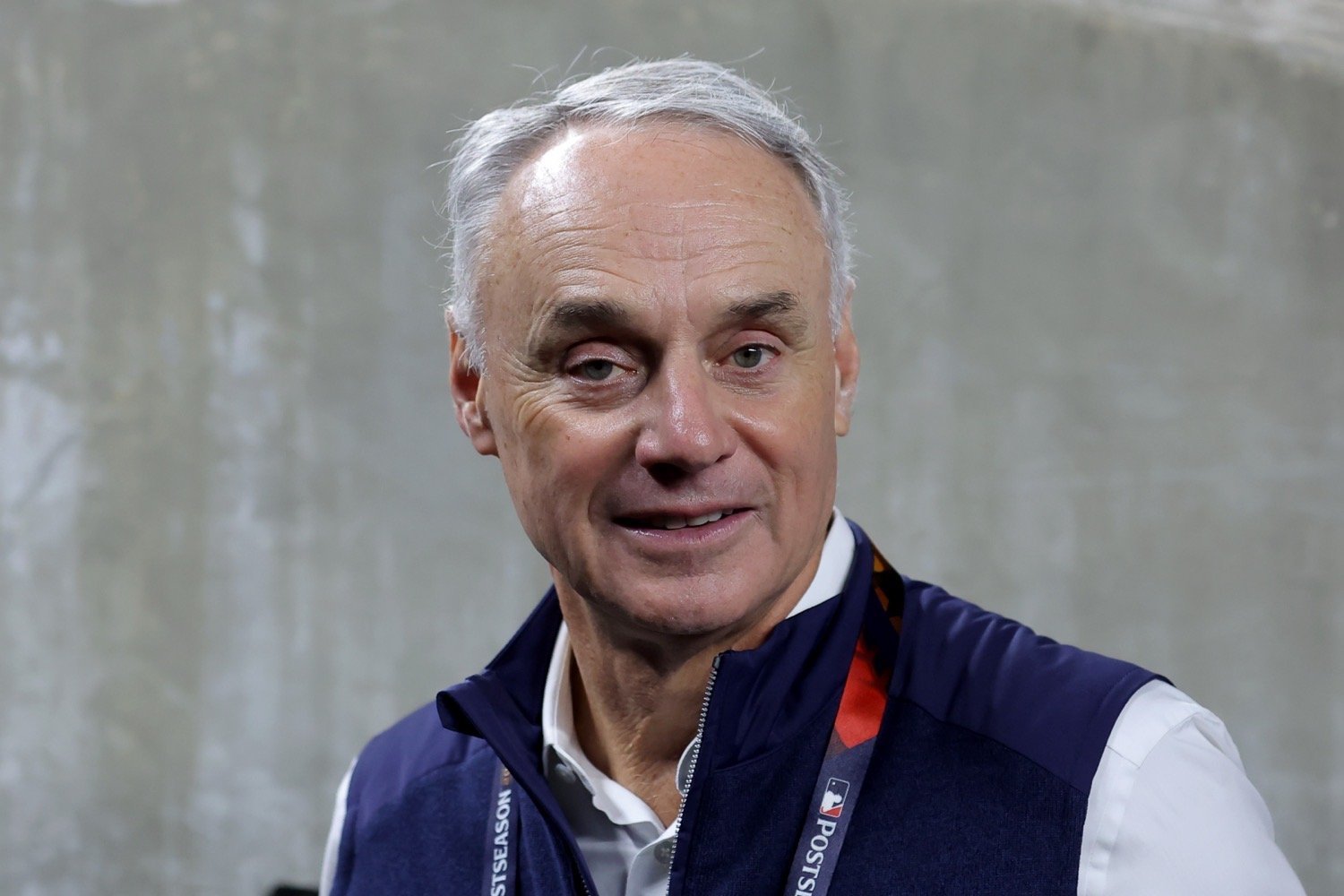
From the league’s side, there is a growing sense that MLB wants to revisit how money is distributed and how teams are allowed, or required, to spend it. Commissioner Rob Manfred has been increasingly open about potential changes, including ideas designed to alter the rhythm of free agency itself. One concept he floated recently was a winter free-agent signing deadline, something that would compress negotiations into a narrower window and potentially create more urgency and attention around the process.
The Players Association, however, appears to be coming to the table with a very different set of priorities. Based on comments made by MLBPA president Tony Clark to The Athletic, the union is focused less on cosmetic changes and more on whether the current system actually promotes competition and fairly compensates players.
“Free agency thrives when competition thrives — on and off the field,” Clark said in a statement to The Athletic. “If the owners are genuinely interested in improving free agency, there are many ways to get there, and we look forward to having that discussion in the coming months."
“But if their true interest is to blow up the very system on which our streak of uninterrupted seasons has been built — with the game reaching record heights and poised to go even higher, no less — that would be a self-defeating miscalculation of massive proportions.”
At the core of this looming negotiation is an uncomfortable reality about how the sport currently operates. Over the last decade, teams in the bottom half of the league by revenue have essentially been shut out of the ultimate goal. No bottom-15 revenue club has won a World Series since the Royals in 2015. At the same time, players collectively receive less than half of league revenues, a smaller share than athletes in any other major American sport.
For many players, the system is doubly restrictive. Half the league enters each season with little realistic chance of winning a championship, and many players are locked into team control for up to six years before they even have access to free agency. When they finally reach that point, the biggest rewards are concentrated among a small group of star players, while the majority remain underpaid relative to the revenue the game generates.
That imbalance is why the MLBPA should be pushing aggressively for structural change. A system that overwhelmingly benefits big-market teams and a handful of superstars while leaving most players with limited earning power and competitive opportunity is difficult to defend. Competitive balance matters not just for fans, but for the health of the union’s membership.
The league, for its part, has increasingly framed the issue as one of incentivizing lower spending clubs to invest more in their rosters. That framing quickly leads to the most polarizing concept in baseball labor talks: a salary cap. When asked recently whether a cap would be a nonstarter in the next negotiation, Manfred was quick to deflect responsibility to the union.
“That’s a Tony Clark question, I mean, it really is,” Manfred said on the radio. “Until I got elected commissioner, all I did was labor relations. That’s how I made my living. I’ve never been in a negotiation where, before the first piece of paper went across the table, I, or anyone I represented, was out there saying, ‘This, we absolutely will not talk about.’ I just think it’s a hard way to begin a negotiation.”
The Players Association has not softened its stance, even if it has not explicitly engaged with every hypothetical. In response to Manfred’s comments, the union emphasized both its priorities and its long memory.
“Players and fans want a full season of competitive baseball,” the MLBPA said. “The league and owners say they want to avoid missing games, but at the same time they appear to be dead-set on trying to force players into a system that, the last time they proposed it, led to the most missed games ever and a cancelled World Series.”
While Manfred has insisted he is not committed to a cap, many of the ideas he continues to reference resemble the economic structures used in cap leagues like the NFL, NBA, and NHL. That includes not just an upper spending limit, but also a salary floor that would require teams to spend a minimum amount on payroll. When asked directly how to encourage low-spending teams to invest more, Manfred pointed to that exact model.
“The question of incentivization is a really important one. Three other sports have dealt with it by having a rule: you got to spend,” Manfred said. “Everybody talks about the cap piece. The cap piece comes with another piece where you have to spend. And I think mandating a certain level of commitment in terms of spending in the right kind of economic system can be a good thing.”
From a competitive standpoint, the idea of a salary floor is difficult to argue against. Under the current system, there is little reason for some smaller market owners to push payrolls higher when the gap between them and the biggest spenders can reach hundreds of millions of dollars. This season alone, the Dodgers’ luxury tax bill exceeds the entire payroll of more than half the league. That is not a sustainable definition of competitive balance.
Manfred has also tied these labor discussions to broader changes in baseball’s media landscape. With regional sports networks continuing to decline and streaming platforms gaining leverage, the commissioner has openly discussed a future where MLB packages both national and local broadcasting rights together in new ways. That kind of overhaul would almost certainly be linked to changes in revenue sharing and labor economics.
“People often say that when you make a (labor) deal bigger, it’s harder to get it done,” Manfred said last summer. “This is one of those areas where a bigger deal, in terms of media, labor, revenue sharing, actually gives you trade-offs to accomplish things.”
Despite the tension, Manfred has repeatedly emphasized the importance of maintaining momentum. The rule changes of the last few seasons, particularly the pitch clock, have revitalized fan interest, something he views as a significant asset heading into negotiations.
“When you have momentum like we have that you’ve worked as hard as we have to get, you know that is a force that puts people in a frame of mind that they should understand they need to make an agreement, OK?” Manfred said. “Despite that momentum, we have a couple of issues that we hear about from our fans all the time: blackouts and the perception that some teams are not competitive.”
Those two issues are deeply intertwined with labor, revenue, and spending rules. How MLB and the MLBPA choose to address them will define the next era of the sport. History suggests that talk of helping small market teams often precedes calls for a cap, but it does not guarantee one. There are paths to reform that stop short of that outcome.
Whether ownership pursues those alternatives or pushes for a more dramatic overhaul remains to be seen. For now, one thing is clear. With the CBA clock ticking and both sides openly staking out philosophical ground, baseball’s next labor fight is no longer a distant concern. It is already here.
What changes do you envision from the next CBA? Leave a comment and start the discussion.
Do you like the automatic runner in extra innings?

Follow DiamondCentric For Major League Baseball News & Analysis


Like what you've read here? Check out our team-specific sites and expand your fandom!










Recommended Comments
If you have an account on one of the following sites, you have a DiamondCentric account.
Twins Daily, Brewer Fanatic, North Side Baseball, Talk Sox, Jays Centre, Padres Mission, Royals Keep, Grand Central Mets, Fish On First.
Create an account or sign in to comment
You need to be a member in order to leave a comment
Create an account
Sign up for a new account in our community. It's easy!
Register a new accountSign in
Already have an account? Sign in here.
Sign In Now